Urban Puritano • August 23, 2026

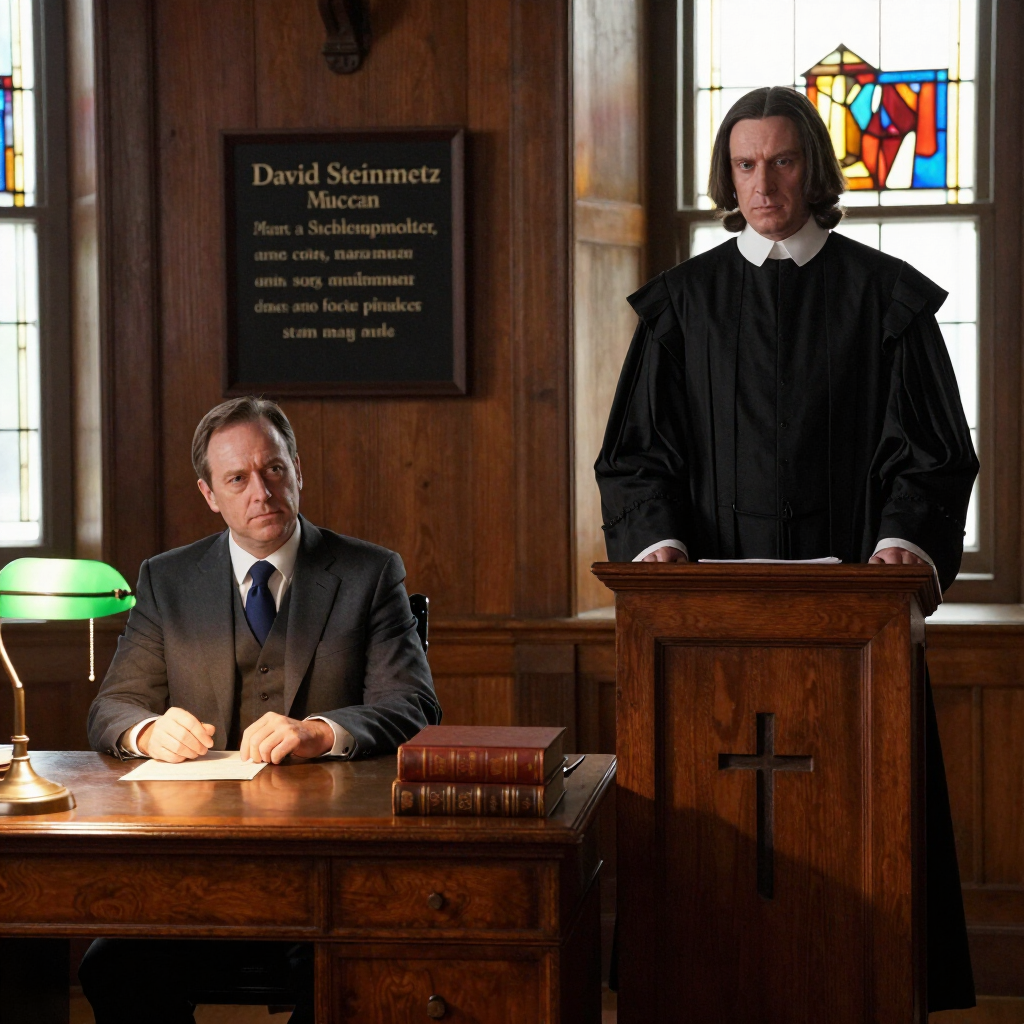
Tom Hicks: Allegorist(?)

This is a subtitle for your new post
The author of What Is a Reformed Baptist? gives baptism four senses — but the engine is allegory's, and his own confession already ruled on it.


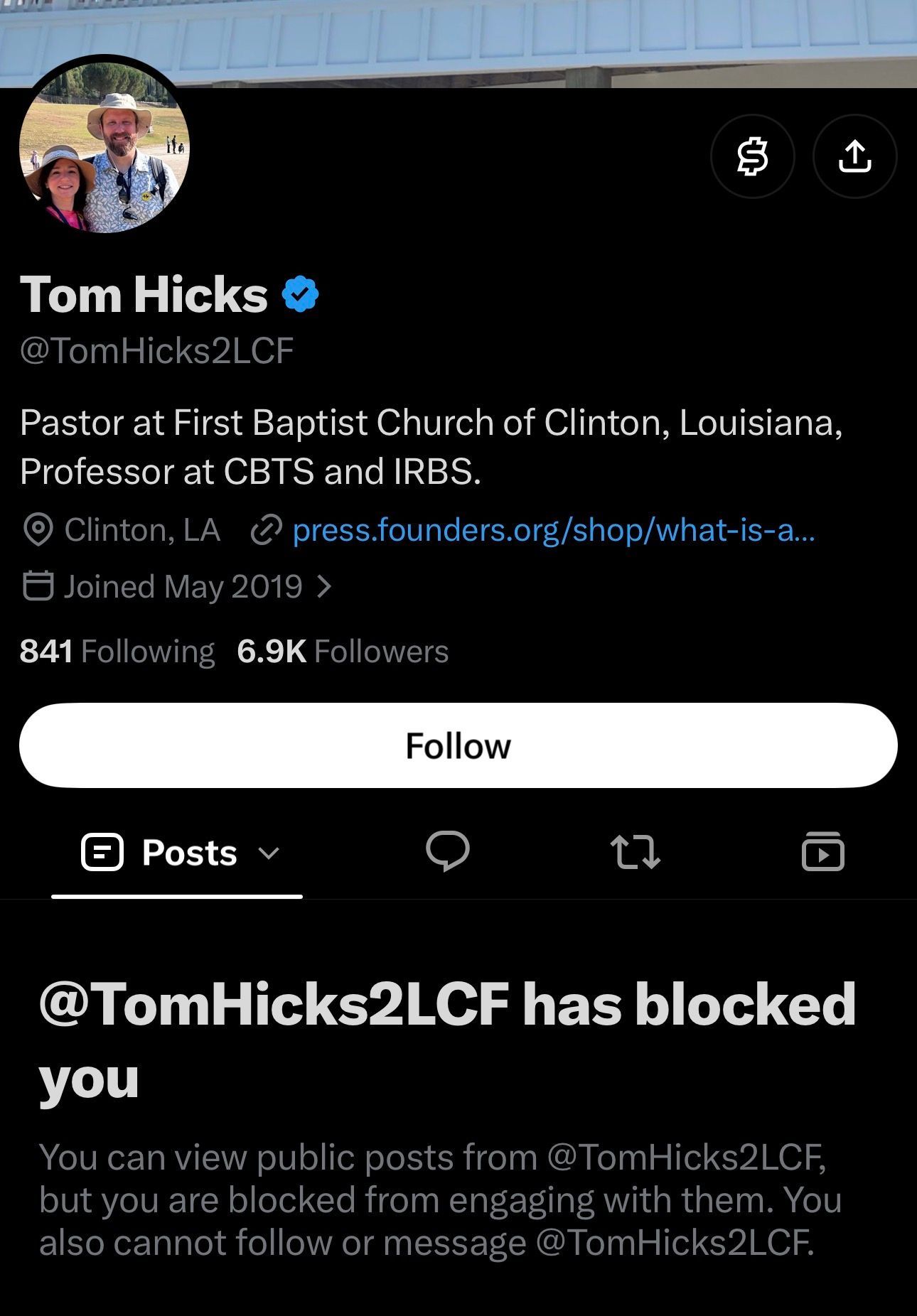
Tom Hicks — a confessional Reformed Baptist pastor whose very handle, @TomHicks2LCF, flies the Second London flag — recently offered on X what he called "the fourfold sense of Christian baptism." Four numbered senses, each pinned to a medieval label: immersion as a sign of union with Christ (literal); a sign of Christ's death and resurrection (allegorical); a sign of the believer's death to self and new life (tropological); a sign of the believer's passing from this world into the next (anagogical).


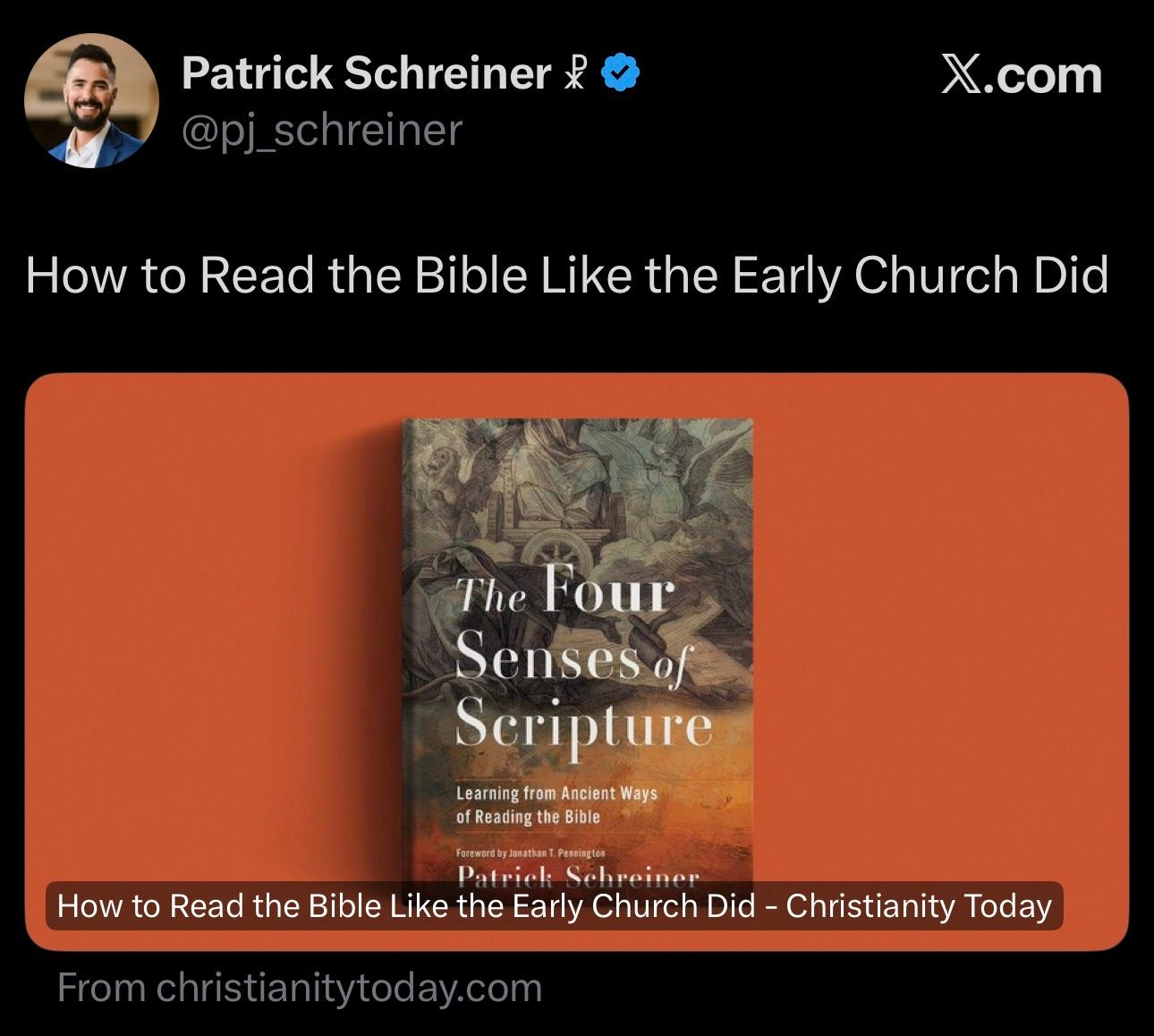
Patrick Schreiner — author of The Four Senses of Scripture, the most prominent recent case for recovering the quadriga — welcomed it: a smile and a "thank you" GIF. The gesture is light. It is also telling, and it is why this small thread repays a longer look. The author of the retrieval's flagship book has just cheered the fourfold method as it steps off the page. What was a claim about how biblical texts mean is now applied, with the movement's blessing, to how a sacrament means.


I want to be careful not to pay this the wrong compliment. One could call the post creative and mean it warmly. But the creativity is the whole problem, not a mitigating grace. A hermeneutic is a discipline: it constrains what a thing may be taken to mean, and tells you when you have gone wrong. A heuristic is a generator: it prompts you to produce, and it never runs dry. The fourfold scheme, turned on baptism, constrains nothing. It generates — four slots, and an invitation to fill them. That a godly and able pastor can fill them so readily is not evidence the method works; it is evidence of what the method is. A scheme that can find its four senses in a text, in an ordinance, in a hymn, in a handshake, is not discovering four senses in any of them. It is running its apparatus, which will always yield four, because yielding four is what it was built to do. Not a bug — the feature.


There is a name for the faculty at work. Pareidolia is the mind's readiness to see a face where there is only cloud; apophenia, its broader cousin, is the readiness to see connection where nothing is in fact connected. The quadriga laid over a sacrament is apophenia in its Sunday clothes — the familiar fourfold silhouette projected onto a subject that never asked for it. Baptism is not a text with a literal sense and three spiritual ones stacked above it. It is one sign, and it signifies richly: union, death and resurrection, new life, the hope of glory — all of it whole and undivided in a single thick redemptive-historical reading of the texts that give it (Rom. 6:3–5; Col. 2:12; 1 Pet. 3:21). Sorting that one meaning into four medieval bins does not multiply the meaning. It multiplies the bins.


And then the thread did the argument's work for it. A reader, Mark Harrelson, noticed a gap: "5. For remission of sins. You missed that one." The fourfold scheme had left out something the Nicene Creed itself confesses of baptism — and a fifth item is an awkward thing to hand a fourfold sense. Hicks's answer has real theological content, and none of it is wrong: Christ procures remission at the cross, faith is the hand that receives it, and baptism asserts and confirms it to the believer. Hold that sacramentology; it is sound. Then watch what the method makes him do with it. Remission, he said, is "contained in the allegorical sense."


The four senses did not produce remission; challenged, they absorbed it, folding a fifth doctrine into a slot already holding another. That is not a fourfold reading yielding its riches. It is an elastic container stretching to swallow whatever the objection supplies. If the allegorical sense can take on remission after the fact — remission, which has no quarrel with the "death and resurrection" already sitting in that bin — then the "senses" are not distinct compartments of meaning the sacrament yields. They are labels roomy enough to relabel. Press them and they expand; and a scheme that expands on demand has stopped dividing anything at all. Remission was never a missing fifth sense. It was already inside the one meaning of baptism, exactly where union and new life and hope already were.


The category error is the surface. The deeper problem is confessional — and here the irony turns tragic. Hicks is no bystander to the Second London; he wrote the book on it. In What Is a Reformed Baptist? he argues that Reformed Baptist identity is confessional identity — that to be a faithful Reformed Baptist is to hold the historic confessions, and the Second London above all. The man who taught a generation that being Reformed Baptist means holding this confession has now read baptism in a way the confession forecloses. He cannot wave the objection off, because it is his own standard, in his own book, that raises it.


The Second London, with Westminster, declares that the true and full sense of any Scripture "is not manifold, but one." Those four words do logical work. "Not manifold" is a denial — not a ranking, not a subordination, but a denial — of multiple senses as such. It denies the genus. And the quadriga, a theory of four senses, is the most prominent species of that genus. The denial of a genus necessarily contains the denial of its species: deny that Scripture's sense is manifold, and you have denied, in the same breath, the fourfold scheme that is manifoldness's flagship. To confess 1.9 is to have already declined the quadriga — and having declined it for texts, one has declined it for whatever else the fourfold silhouette gets projected onto next.


This is no novel reading of the phrase. It is the plain force of "not manifold," and it is how the confessional tradition treated the question. Tyndale, Perkins, Whitaker, Leigh, and Turretin did not say the spiritual senses must be kept subordinate to the literal. They said Scripture has one sense. The men who wrote "not manifold, but one" were denying multiplicity, not tidying it into a hierarchy.


The confession does not only deny; it directs. Having called the true and full sense "not manifold, but one," the same article says how the one sense is found: it "must be searched and known by other places that speak more clearly" — Scripture set beside Scripture, read under the analogy of faith. That is the confessional method for establishing a doctrine's full meaning, baptism included: not four bins to be filled, but the gathering of every text that bears on the sign into one coherent teaching. Remission belongs to the doctrine of baptism not because it can be tucked into an allegorical slot, but because Scripture, searched and known — Acts 2:38 beside Romans 6, and the creed's "one baptism for the remission of sins" — teaches it as part of the one thing baptism signifies. The analogy of faith is intertextual, not fourfold. What was offered under the name of depth is a medieval grid standing in for the confession's own method — and standing in for it poorly, since the grid had no slot for remission until someone pointed out the lack.


There is a stock reply that this is simply not what the Confession means. But asserting that "not manifold, but one" leaves room for other distinct senses is not an argument; it is the very thing to be shown, and it owes three unpaid debts: an alternative reading of the actual words "not manifold, but one"; historical evidence that the framers meant to leave a door open for distinct senses; and some account of the genus–species relation on which a man may deny multiple senses and keep four of them. Until those are produced, the four words stand.


So — allegorist? Not by conviction. Hicks would reject the label, and the confession he wrote a book to commend rejects it for him. The charge was never that he holds allegory's creed. It is that he has borrowed allegory's engine and set it running against the very standard he taught the churches to keep.


The soft retrieval keeps arriving at the same wall, and it arrives now in a new field. Whether the fourfold sense is offered for a passage or for the ordinance of baptism, the confessional verdict does not move, because it was never aimed only at texts. It was aimed at manifoldness itself. The waters are rich — rich with union, death, resurrection, new life, remission, and the hope of passing through the last judgment into glory. But that is the fullness of one sense, not the sum of four.


There is a leaven here, and it is spreading. The manifold sense of Scripture, long resisted among Baptists, has found a welcome among Reformed Baptists — and now it has jumped the tracks a second time, from the senses of a text to the senses of a doctrine. A fourfold sense of baptism today; a fourfold sense of the Supper, the church, the covenants tomorrow. Each step is greeted as recovery, as depth. But none of it is the confessional framing of the analogy of faith, and a little leaven leavens the whole lump. What spreads here is not a retrieval. It is a grid mistaken for a method, and a trend mistaken for a tradition.


Heuristic, not hermeneutic. Not manifold, but one.


POST SCRIPT...


Pastor Tom kindly unblocked me and replied to my X article:


"Thank you for the post and the generous interaction. Allegory in the medieval usage was often severed from the meaning of the text and generated fresh meaning independent of the what the Word of God actually said. When the Reformers opposed allegory, that is what they opposed. But at other times, the Reformers employed allegory, but only when it was anchored in the one meaning of the text. 


Benjamin Keach was a faithful English Particular Baptist pastor who signed the Second London Confession of Faith. He wrote a massive interpretive tome titled Tropologia in which he proceeded to open the allegorical/typological, metaphorical, and tropological senses of Scripture. You can research it using AI and Google. He did not believe the one sense of Scripture is limited to the literal sense but expanded to typology and allegory and tropology. The same method of interpretation is evident from the preaching of Charles Spurgeon (often maligned by literalists). But these Reformed Baptist brethren didn't see any conflict with our venerable confession because there isn't any. It is found throughout our Reformed and Particular Baptist heritage. Tolle lege.


The procedure of looking for the meaning of the text, how it points to Christ, how to apply it, and how it gives us hope for the future, arises from studying the way that Jesus and the apostles themselves studied the Bible. 


While I don't have space to work it out fully here, consider just one example from the author of Hebrews which is Paul, in case you were wondering. :) See Hebrews 12:5-6 and the manner in which the preacher handles the biblical interpretation of Prov 3:11-12. Context shows a fourfold sense. First, there is the plain sense. This is the truth that God trains or disciplines His sons. Second, there is the Christ-centered sense. God led Christ to the cross (Heb 12:2), and Christ learned obedience through suffering (Heb 5:8). He did this for us as our substitute and example. Third, there is the applied sense. God loves us, Christ teaches us how to suffer in love; therefore, in light of Christ, we can embrace suffering and persevere in love without becoming weary or fainthearted, knowing we are being made like Christ (Heb 12:11). Fourth, there is the final or heavenly sense. The goal of our training in sanctification is ultimately to see the Lord (Heb 12:14). 


Many other such examples of the Bible's interpretation of the Bible in this way could be shown. There is only one sense of the text. But that one sense is often though not always multilayered with many necessary implications."


To which I replied:


"Appreciate you for unblocking me to exchange replies. While some people decry this app, i find you get what you invest in it. Your input is greatly appreciated. I understand you may write more wherever you choose is best. 

My good faith yet pointed response will be a short list of where I consider you unhelpfully and sloppily blurring the lines logically, biblically, and confessionally:


The first and most obvious: the 4fold sense as a tool for reading texts, versus interpreting a doctrine (e.g., baptism).

A figure of speech, versus a second sense.

Typology, versus invented allegory.

Preaching a text, versus interpreting a text.

Rejecting a method’s abuses, versus rejecting the method; illicit to overlay even the quadriga’s structure on our confession.

And a big one: the implications of one meaning, versus four different senses or meanings."


Please, stay tuned and be on the lookout for an episode of the Urban Puritano Podcast for a discussion of these issues.


Share

By Roberto Gazga August 9, 2026
The body content of your post goes here. To edit this text, click on it and delete this default text and start typing your own or paste your own from a different source.
By Urban Puritano August 8, 2026
The body content of your post goes here. To edit this text, click on it and delete this default text and start typing your own or paste your own from a different source.
By Urban Puritano July 27, 2026
Patrick Schreiner has asked for something reasonable, and I want to grant it before I disagree with anything. In a recent excerpt at *Christianity Today*, drawn from his book *The Four Senses of Scripture*, he opens with the interpretation everyone loves to condemn: Augustine on the Good Samaritan. The man going down to Jericho is Adam. The thieves are the devil and his angels. The priest and the Levite are the old covenant ministry, which could profit nothing for salvation. The Samaritan is Christ. The inn is the church. The innkeeper is the Apostle Paul. Modern instructors, Schreiner observes, hold this up as a specimen of how not to read. He asks us to slow down. We ought not to reject such a reading, he says, if we refuse to enter the worldview and reading strategy that produced it. Understanding is not agreement, but we can at least understand why a man like Augustine read a parable this way. Granted. Entirely granted. Augustine was not a fool, he was not playing games, and the men who read the parable as he did — Origen before him, Aquinas after him — were serious men doing what they believed the text required. Anyone who cannot say that much has not earned the right to disagree. So let us enter the reading strategy, exactly as invited. And let us do it the way Schreiner himself proposes: not theoretically, but by going to the Scriptures. "The proof is in the pudding," he writes. I agree. So I want to take his own worked example and test it by his own stated rules. That is the whole of what follows. I am not going to argue that the fourfold sense is unhistorical, or that its practitioners were unspiritual, or that the men who used it loved Christ less than we do. I am going to ask whether the example given to demonstrate the method actually demonstrates it. Who speaks for the other side? First, though, a word about who is standing in the dock. When the essay turns to the position it means to correct, the man who appears is Benjamin Jowett. Scripture has one meaning, Jowett says: the meaning it had to the mind of the prophet or evangelist who first uttered or wrote it, and to the hearers or readers who first received it. The interpreter must not add another meaning but recover the original one. We are to read the Bible like any other book. That is a real position, and it is fairly quoted. But it is worth knowing whose position it is. Benjamin Jowett was Master of Balliol College (Oxford), and the essay in question comes from *Essays and Reviews*, published in 1860 — a volume so far from confessional orthodoxy that two of its contributors were prosecuted in the ecclesiastical courts. Jowett was not defending the single sense of Scripture as the Reformed churches confessed it. He was proposing that the Bible be handled like any other ancient book, which is precisely what the Reformed churches denied. So the reader is offered two options. He may have Jowett's single meaning according to the historical critical method, thin and historical and closed at the moment of first reception. Or he may have the fourfold house. Put that way, most Christians with any spiritual instinct will take the house, and they will be right to. But there is a third position, and it is the one the confessions actually hold. Here is the Westminster Confession, and the Second London Baptist Confession after it, at 1.9: "The infallible rule of interpretation of Scripture is the Scripture itself: and therefore, when there is a question about the true and full sense of any Scripture (which is not manifold, but one), it must be searched and known by other places that speak more clearly." Read that carefully, because it is doing two things at once, and both matter. It says the sense of Scripture is one, not manifold. That is the denial of the quadriga, stated as plainly as a confession can state anything. But look at what it says in the same breath. The true and full sense. Searched out by other places that speak more clearly. Scripture interpreting Scripture, across the whole canon, under a divine Author who wrote all of it. That is not Jowett. Jowett's meaning is sealed inside the mind of the first writer and the ears of the first hearers. The confession's single sense reaches wherever the canon reaches, because one Author stands behind the whole of it. This is not a small difference. It is the difference between a text with one thin meaning and a text with one true and full meaning. And it is the position that never appears in the essay. I do not say this was done deliberately. I say it happened, and that it determines everything downstream. If the only alternative to four senses is Jowett, then four senses wins by default. The reader never meets the position the confessions actually took, so he is never given the chance to prefer it. The proof in the pudding Now to the example. Schreiner takes Matthew 23:37 — "O Jerusalem, Jerusalem, the city that kills the prophets and stones those who are sent to it!" — and reads it four ways. Literally , Jerusalem is the historical city: taken from the Jebusites, made David's capital, later the capital of Judah, and now the city Jesus enters on his way to the cross. Allegorically , Jerusalem stands for all God's people who have killed the prophets, past, present, and future. He cites Galatians 4:25. Tropologically , Jerusalem represents the individual human soul. Christ's lament is personal. He longs for you and me to have our hearts opened to him. We should not be like historical Jerusalem, which sought to kill him. Anagogically , Jerusalem reminds us of the New Jerusalem, and Christ's cry looks forward to the day when his city will welcome him. He cites Galatians 4:26, Hebrews 12:22–23, and Revelation 21:2. Now look at the citations, because they are not distributed evenly. The allegorical reading has a verse. The anagogical reading has three. The tropological reading has none. Hold that, and consider what the cited verses are actually doing. Galatians 4 is Paul reading Jerusalem in two registers. Hebrews 12 is the writer setting Mount Zion and the heavenly Jerusalem before the church. Revelation 21 is John seeing the city come down. In every case the connection between Jerusalem and the thing Jerusalem is said to mean is made by Scripture itself. That is not a second sense laid over the text. That is the confession's own rule: the true and full sense of one place searched out by other places that speak more clearly. When Schreiner reads Matthew 23 in light of Galatians 4, he is not doing something the single sense forbids. He is doing the very thing the single sense requires. I would read it the same way, and so would every Reformed commentator I know. Which leaves the tropological. Here there is no verse, because there is no verse to give. No apostle tells us that Jerusalem signifies the individual soul. The claim arrives on its own authority. And notice what follows it: Christ's lament is personal; he longs for our hearts to be opened; we should not be like the city that killed him. Every word of that is true. Every word of it is preachable. But not one word of it is a second sense. It is application — the pressing of the one meaning upon the conscience of the hearer. Preachers have done it from the single sense since the apostles, and no one needed a fourth tier to do it. If Jerusalem's killing of the prophets means what it plainly means, then a man who reads it and does not tremble has misread it. That is not a further sense of the text. That is the text landing where texts are meant to land. So the example divides cleanly. Where the reading is warranted, it is warranted by the canon — and the canon read whole is the single sense, not an alternative to it. Where the reading is genuinely distinct from the literal sense, no warrant is offered at all. The same pattern holds in his second example. The Psalms, he says, are Israel's songs literally, Christ's songs allegorically, our songs tropologically, and new-creation songs anagogically. The anagogical reading gets citations: Revelation 5:13, Psalm 145:21, Psalm 150:6. The tropological gets a sentence about the new covenant and no text. Twice now, in the two examples chosen to display the method, the moral sense arrives without a verse. I want to be careful here. I am not saying Schreiner has no verses in his book; I have not read every page of it, and an excerpt is an excerpt. I am saying something narrower and, I think, harder to wave off. These are the examples he selected to show the method working. If the demonstration cannot supply canonical warrant for one of its four senses in either instance, the reader is entitled to ask what is holding that sense. A house, or a seed? The essay's governing image is a house. The literal sense is the foundation, the allegorical the walls, the tropological the furniture, the anagogical the roof. It is a beautiful image, and it is very old. It is also, precisely, an image of addition. A foundation does not become walls. Furniture is carried in from outside and set on a floor that was finished without it. Four materially distinct things are assembled into one structure, and the structure is only complete when all four are present. Which is why the essay must say what it says next: you cannot read rightly without attending to the christological sense, or the moral sense, or the eschatological sense. Without these, the house is not yet constructed. There it is — the load-bearing claim of the whole enterprise. Not that the fourfold sense is edifying, or ancient, or reverent, but that the literal sense by itself is not enough. A foundation with no walls is not a house. It is a slab. And here the essayist is caught by his own hand, for elsewhere he concedes what this claim cannot survive. In a public disputation he grants: “Every text has a literal sense. Not every text has a spiritual sense” (Kenwood Institute disputation, youtu.be/eJx1i7Mb6a0 ). Set that beside the house. If some texts have no spiritual sense, then for those texts the house is finished at the foundation — complete, habitable, whole, with no walls, no furniture, and no roof. The slab, it turns out, is sometimes the whole building. But a foundation that is already a finished house for one text cannot be a mere slab for the next, unless some rule tells us which texts get the upper storeys and which do not — and no such rule is offered. He has conceded the sufficiency of the single sense for an unnamed number of passages, while giving no reason the same sufficiency should not extend to the rest. Notice the irony. The whole case against the single sense is that it is Jowett’s — thin, flat, the bare letter and nothing more. Yet the texts he grants a literal sense only, he does not treat as thin; he treats them as sufficient. Which is precisely the confession’s claim, and never Jowett’s: one sense, and full. The retrieval has been fighting the thin single sense so hard it never noticed the thick one standing beside it — the one it half-holds itself. But then, in nearly the same breath, the essay says something that pulls hard the other way. The other senses must find their grounding in the literal, or they will collapse. Allegory must grow from the literal. Grow . That is a seed, not a scaffold. And the two images cannot both be true. If the further senses grow out of the literal the way a stalk grows out of a seed, then they were in the seed, and what we have is one thing unfolding — which is exactly what the single sense claims. If they are walls set upon a foundation, then they came from somewhere else, and the mason brought them. You may have organic growth or you may have construction. You may not have both, and the argument needs both: growth to escape the charge of adding to Scripture, construction to justify the number four. There is a third phrase, quieter than the others, where the whole issue is compressed into a single verb. The literal sense, we are told, contains, discloses, but also veils the mystery of Christ. Contains and discloses I can affirm without hesitation. But veils is doing an enormous amount of work. If the letter veils, then something else must unveil, and a second sense becomes necessary by definition — not because it was shown to be necessary, but because the literal sense was described in a way that guarantees it. The conclusion is loaded into the premise. Change one verb and the argument for a second sense evaporates. One more feature of the house deserves naming, because the essay leans on it. The four senses are presented in what it calls a “Protestant order” — the literal first, the foundation from which the others must grow, on pain of finding Christ where he should not be found and drifting into heresy. The instinct is right: sever allegory from the letter and you get chaos. But notice what the safeguard costs. If the upper senses must grow from the literal, organically, or else collapse, then they are the literal unfolding — one sense reaching its full measure — not a second sense resting on a first. The tighter the essay binds the spiritual senses to the literal to keep them safe, the less they look like distinct senses at all. And whatever this reordering is, it is not the Protestant doctrine of Scripture’s sense. Reordering the quadriga’s four is not the same as holding what the Reformed churches confessed — that the sense is not four in any order, but one. Where the four came from One more question, and it is the one I cannot get past. Why four? The essay is candid, and I respect the candor. Christian interpreters began distinguishing senses early, it says, though the four were not solidified until later. John Cassian, who died around 435, named the four in his *Conferences*. Before that, the evidence offered is the *Epistle of Barnabas*, which says Moses spoke spiritually. But "spiritually" is not a number. It is not even a claim about how many senses a text has. It is a word that says: do not read this woodenly. Tyndale would have said the same. So would Calvin. So would any confessional Protestant who has ever preached from Leviticus. So the pedigree divides. The antiquity belongs to reading spiritually, which nobody in this argument denies. The number four is fifth-century and later, which the essay itself concedes. And where does the number come from? The essay tells us, in a line from Bonaventure that is quoted for other reasons. By tropology we are taught how to act; by allegory, what to believe with faith; by anagogy, what to desire for our eternal delight. Believe, act, desire. Faith, love, hope. The three spiritual senses are the three theological virtues. The correspondence is not an accident and it was never hidden; it is the traditional mapping, and it is elegant. But notice what it means. The number of senses is fixed by a schema of the Christian life, not derived from any feature of any text. Nothing in Matthew 23 tells you to expect three spiritual senses rather than two or five. The count arrives from outside and is applied. That is worth sitting with. When we ask the quadriga why there are four senses, the honest answer is not exegetical. It is that a beautiful and coherent account of the soul's life happened to have three parts, and a foundation was laid beneath them. One last thing about senses There is a technical moment in the essay that I suspect will pass most readers by, but it deserves a paragraph. Schreiner introduces a distinction to explain what the fathers meant. Sense, he says, refers to what someone says, while reference refers to what that something is about. Good. That is a real and useful distinction, and it is the right tool. Then comes the application: the four senses affirm that there can be four different, though connected, referents. But by the definition just given, four referents are not four senses. They are one thing said, about which several things are true — or toward which several things point. And the confession does not deny that Scripture has many referents. It denies that Scripture has many senses. "Not manifold, but one" is a claim about what the text says, not about how many realities the saying touches. If what the retrieval actually wants is that Christ, the church, the soul, and the age to come are all bound up in what Matthew 23:37 is about, then I do not think any confessional Protestant needs to object, and the label "four senses" is a misnomer for it. If the retrieval wants four things said, then it needs to show that from a text, and the Jerusalem example did not. What I am not saying I am not saying the impulse behind this book is wrong. It is not. Schreiner is right that much modern interpretation is thin, that Christ is genuinely everywhere in the Scriptures, that the text is meant to be lived and not merely studied, and that our reading ought to end in hope. If the choice were between the fourfold sense and a Bible flattened into an ancient history lecture manuscript, I would probably take the fourfold sense without blinking. This might be the quadriga's appeal to some Reformed preachers to inject their preaching with rhetorical inspiration for their homiletical inertia. But I digress. But that is not the choice, and I think the essay's structure obscures the fact. Notice how it begins and how it ends. It begins with Augustine's Samaritan — the hardest case, the one everybody condemns — and asks us not to dismiss it too quickly. It ends by calling the fourfold sense faithful , helpful , historic , and holistic , a hermeneutical house we can live in. Between those two points, the Samaritan is never adjudicated. We are never told whether the innkeeper is Paul. We are told that Augustine had reasons, that his method was widely shared, and that the method is good. But the question the essay raised in its first paragraph is left where it was found. And it is a fair question to press, because the method has to answer it. Is the innkeeper Paul? If yes, on what grounds? If no, on what grounds? A reader who wants to say no needs a rule that the method can supply, and I cannot find one in the essay that would do it — nothing except the judgment of other readers, which is not a rule about the text at all. That is what four adjectives cannot fix. Faithful says the reading is permitted. Helpful says it is useful. Historic says it is old. Holistic says it is comprehensive. Every one of those may be granted, and not one of them shows that the single sense of Scripture is insufficient. Yet insufficiency is the claim the whole house rests on: without these, the house is not yet constructed. Show me that. Not that a fourfold reading is edifying — I will stipulate that it often is. Show me a text whose meaning cannot be had unless a second sense is added to it, and show me the rule that tells us when to add one and when to stop. The charity that ran dry Return, at the end, to where the essay began. It opened by asking us not to dismiss Augustine’s Samaritan too quickly — to enter the reading before rejecting it. It was a fair request, and I have tried to honor it throughout. But notice where the charity was spent, and where it ran dry. Every hospitality was extended to a fourth-century allegory the church has almost entirely set aside. None was extended to the position the Reformed confessions actually hold — that the sense of Scripture is not manifold, but one. That position was not entered and answered. It was not named. So I will ask for the same charity the essay asked for Augustine, and ask it for the confession instead. Before we are invited to give a reordered quadriga a hearing — an order the Reformed confessions never taught — the single sense those confessions did teach might be given the hearing it never received here. Enter that worldview first. Until then, I will keep the confession's answer, and I do not think it is the thin thing the essay's alternative makes it out to be. The sense of Scripture is one. It is also full — searched out by other places that speak more clearly, spanning a canon written by one Author who knew the end from the beginning, pressing on the conscience of every man who reads it, and opening onto the city that is to come. That is not a slab. That is already a house, and Christ laid it. Responding to Patrick Schreiner, "How to Read the Bible Like the Early Church Did," Christianity Today (July 2026), excerpted from* The Four Senses of Scripture: Learning from Ancient Ways of Reading the Bible *(Baker Academic, 2026). Be sure to keep an eye out for my forthcoming book on the single sense of Scripture as Biblical, rational, and confessional. 

Check the Urban Puritano Shop